


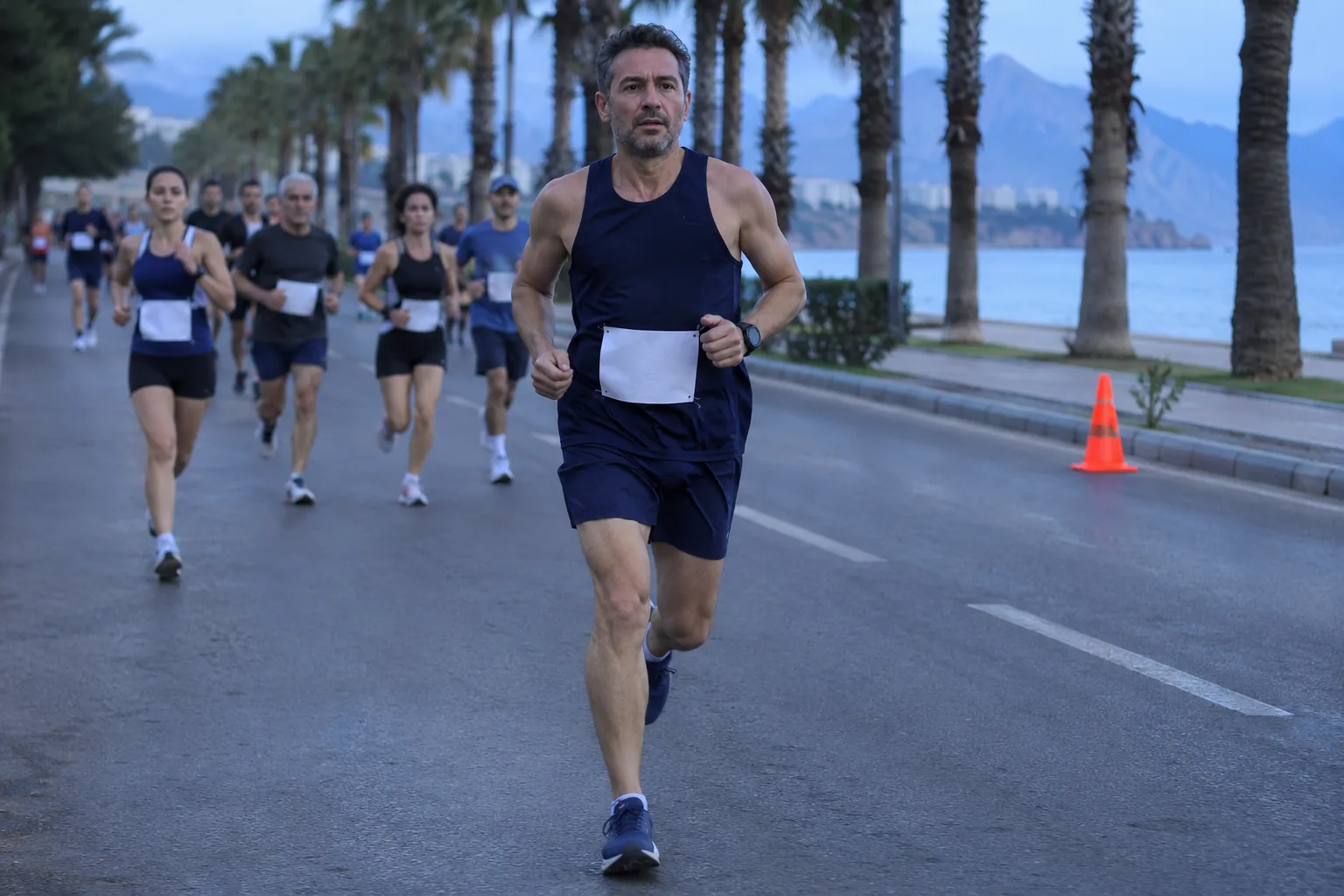
A runner on the Konyaaltı seaside path at dawn
A female athlete deadlifting a barbell in a gym
Footballers doing a passing drill on an artificial pitch under evening lights
A female sprinter set in the starting blocks on an athletics track

Lane 1Running

A long-run day
is not
a rest day.

Nutrition written around your weekly mileage, tempo days and race calendar. In person in Antalya or online.

Choose your sport

A marathon runner and a weightlifter of the same weight do not need the same plate. We start with the sport itself: duration, intensity, sweat, training time.

Running and endurance

Carbohydrate needs rise clearly with mileage. Long-run days, tempo days and rest days need different plates; in-race fuelling is rehearsed in training months ahead.

  • Carbohydrate by weekly mileage
  • 30–60 g fuel per hour on long runs
  • Sweat and sodium in the heat

Calculate for this sport

Macro calculator

Enter your weight, training time and goal to see approximate energy, protein, carbohydrate, fat and fluid needs for a training day and a rest day. For information only, not a personal plan.

You
Training

—kcal / day (approx.)

Carbohydrate
—
Protein
—
Fat
—
Fluid
—

Your weight, height and age are calculated only on this page, in your browser. They are not sent to the server or stored.

Ranges: ACSM / Academy of Nutrition and Dietetics / Dietitians of Canada joint position (2016), ISSN position stand on protein (2017). Energy: Mifflin-St Jeor + MET.

Book for a personal plan

Training day fuel plan

A day for an athlete who trains at 18:00. Zero is the moment training starts; the cards come before and after it.

  1. −10:0008:00 · start of the day

    Breakfast: 2 boiled eggs, White cheese, olives, tomato, cucumber, 1 slice of wholewheat bread, Oats with walnuts and banana, Water or tea

    Breakfast

    • 2 boiled eggs
    • White cheese, olives, tomato, cucumber
    • 1 slice of wholewheat bread
    • Oats with walnuts and banana
    • Water or tea

    The first share of protein spread through the day; starts filling carbohydrate stores for the evening session.

  2. −03:003 hours before

    Lunch: Bulgur pilaf, Grilled chicken breast, Shepherd's salad, A bowl of yoghurt, Water

    Lunch

    • Bulgur pilaf
    • Grilled chicken breast
    • Shepherd's salad
    • A bowl of yoghurt
    • Water

    1–4 g of carbohydrate per kilo 1–4 hours before training; fat and fibre kept moderate so the stomach is comfortable.

  3. −01:1560–90 min before

    Snack: 1 banana, 2–3 dates, A small bottle of ayran, A few dried apricots

    Snack

    • 1 banana
    • 2–3 dates
    • A small bottle of ayran
    • A few dried apricots

    Easily digested carbohydrate. Nothing new; if your stomach is sensitive, water instead of ayran.

  4. 00:0000:00 · go

    Training: Water, A carbohydrate drink or dates in sessions over 60 minutes, An electrolyte drink in the heat

    Training

    • Water
    • A carbohydrate drink or dates in sessions over 60 minutes
    • An electrolyte drink in the heat

    Water is usually enough under one hour. In longer sessions 30–60 g of carbohydrate per hour supports performance.

  5. +01:4530 min after finishing

    Recovery: Yoghurt with oats, banana and honey, Wholewheat sandwich with white cheese, A glass of ayran

    Recovery

    • Yoghurt with oats, banana and honey
    • Wholewheat sandwich with white cheese
    • A glass of ayran

    About 0.3 g protein and 1 g carbohydrate per kilo; fluid lost is calculated by weighing and replaced.

  6. +03:3021:30 · end of the day

    Dinner: Grilled sea bass, Bulgur pilaf, Green salad with rocket and lemon, Red lentil soup, Water

    Dinner

    • Grilled sea bass
    • Bulgur pilaf
    • Green salad with rocket and lemon
    • Red lentil soup
    • Water

    The day's last share of protein and vegetables; heavy fatty meals before sleep are avoided.

Amounts are an example for a moderate 60–90 minute session. They are personalised in the consultation for stomach comfort, training time and sport.

A football player holds the hand grips of a body composition analyser while the dietitian watches the screen

Body composition analysis

Instead of a single number on the scale: fat and fat-free mass, body water and how they change over time. Measured with a bioelectrical impedance device under the same conditions each time.

What does it show?

  • Whether a weight change comes from fat or muscle
  • Whether muscle mass is kept during the season
  • Large deviations in fluid balance
  • One more piece of data on whether the plan works

What does it not show?

  • A diagnosis or your health status
  • Performance itself
  • An exact body-fat figure from one reading (the trend matters)

Before the measurement: no food for 3 hours, no hard training for 12 hours, same time of day and after using the toilet. Not done with a pacemaker, metal implants or during pregnancy.

Body composition service

Packages

Bar length is the package length. There is no checkout: you apply and we decide together in the intro call whether it fits.

  1. Pre-season block

    To start the preparation phase with a steady plate.

    1 + 2 sessions6.500 TRY

    Apply
  2. Race preparation

    Eight weeks out from the target race.

    1 + 4 sessions + race week11.500 TRY

    Apply
  3. Season block

    A long period with a changing load.

    1 + 6 sessions16.500 TRY

    Apply

Package details

Burak Şen, dietitian, in a navy training top in the consultation room
Burak Şen, RDDietitian · Sports and performance nutrition

For nine years I have asked athletes on the track, in the gym and on the pitch the same question: what fuel are you doing this session on?

After studying Nutrition and Dietetics at Akdeniz University I specialised in sports nutrition. In Antalya I work in person and online with athletes of every level, from amateur runners to professional team players.

  1. 2013–2017Nutrition and Dietetics (BSc)Akdeniz University, Faculty of Health Sciences
  2. 2017Nutrition placement with a youth football teamAntalya
  3. 2018Sports nutrition certificate programmeDistance, 120 hours
  4. 2019Body composition measurement and assessmentPractical training
About me
A coach, the dietitian and young football players talking at the edge of the pitch under evening lights

Clubs and schools

Team nutrition is not the sum of individual plans: the canteen menu, away days, post-match recovery and young players' school days are planned on the same sheet.

  • SeminarA 60–90 minute practical talk for athletes, coaches or parents: training-day plate, match day, fluids.
  • Season planA team nutrition plan for pre-season, season and break; canteen and away-day advice, monthly check-in.
  • Measurement daySquad body composition at your venue or the office; short feedback for each athlete, a group summary for the coach (with consent).
Ask for a club quote

Articles

All articles

Question board

How is sports nutrition different from a normal diet?

The starting point is training, not weight. Session length, intensity and timing set daily energy and carbohydrate needs, so a training day and a rest day have different plates. The aim is not to get thinner but to train and recover well; if a weight change is needed it is planned around the training calendar.

Do I need protein powder?

Most athletes can meet protein needs with eggs, dairy, meat, fish and pulses. Powder is an option when convenience matters (after training at work, on the road); it is not essential. If you use one, I recommend a product independently tested for doping risk.

When should I start eating on a long run?

In runs over 60–75 minutes, in-race fuelling is practised. Usually from minute 30–45 at regular intervals, starting with 30–60 g of carbohydrate per hour. The stomach adapts too, so no new gel or drink on race day.

Does eating after an evening session make me gain weight?

No; weight change is set by the day's total energy balance, not the clock. A meal with protein and carbohydrate after an evening session supports recovery. For sleep quality it is enough to avoid heavy, fatty meals right before bed.

What should I bring to the first consultation?

Your last two weeks of training, a three-day food record (a training day, a rest day and a weekend day) and photos of the labels of any supplements. If you have lab results from the last six months you can show them in the session; do not write them in the form.

Do online sessions work as well as in person?

Planning and check-ins work the same way online. The difference is body composition: for online follow-up I ask you to measure at home with the same scale and tape at the same time. When you are in Antalya an analysis can be added.

All questions

An amateur female runner crossing the finish line on a seaside road

The first step:
15 minutes.

In a free intro call we talk about your training calendar and goal; I tell you plainly which service fits, or that you do not need one.